



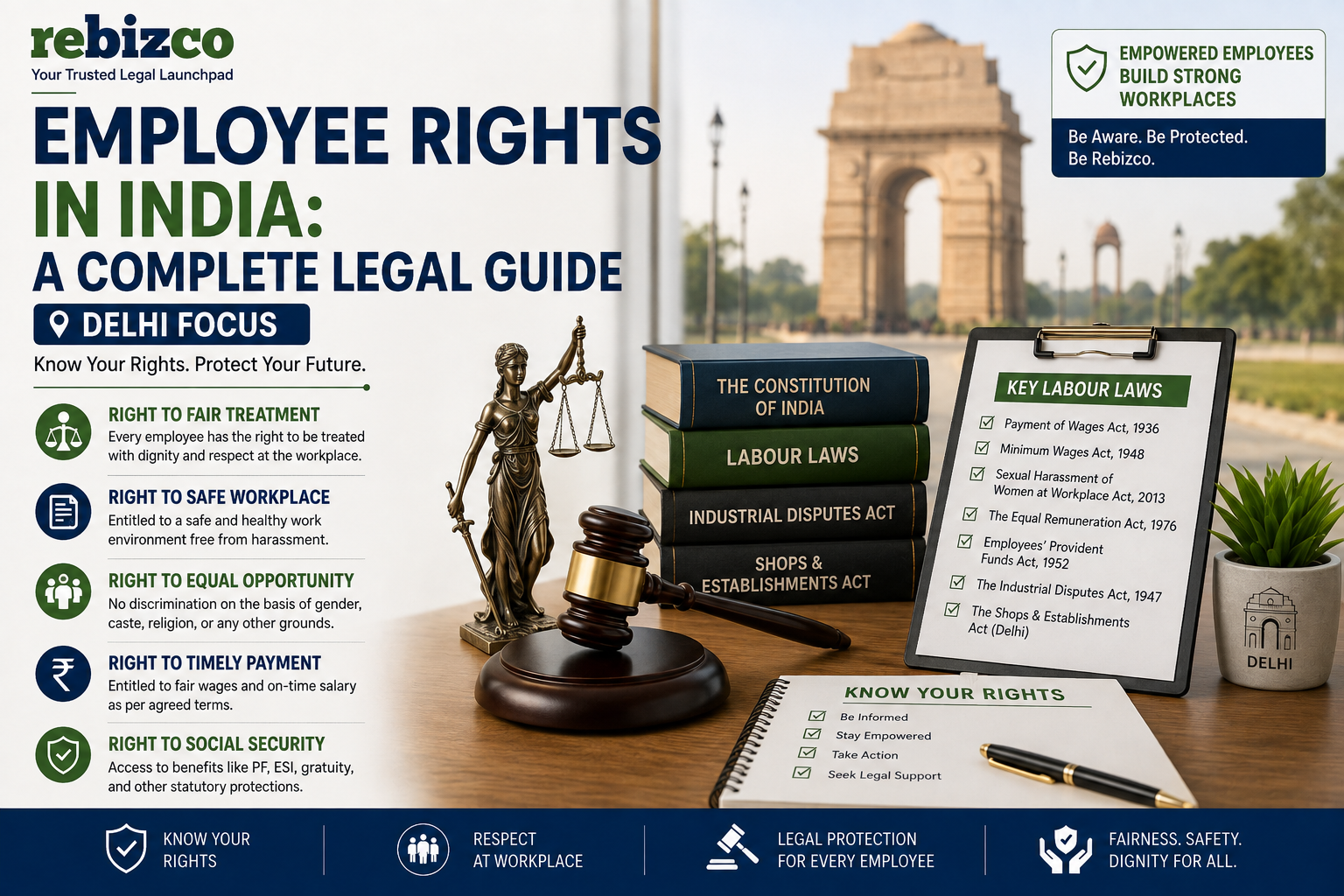
Every employee deserves fair treatment at work. Indian labour laws provide important protections related to wages, working conditions, social security, termination, and workplace safety.
Employees in Delhi should also understand the local complaint mechanisms. The right legal remedy can depend on the employee’s job role, workplace, salary, and type of dispute.
India’s four Labour Codes came into force on 21 November 2025. These Codes replaced and consolidated several earlier labour laws. They cover wages, industrial relations, social security, and occupational safety.
This guide explains the key employee rights India labour law protections in simple language.
What Are Employee Rights in India?
Employee rights are legal and contractual protections that apply to people at work. These rights can cover salary, minimum wages, working conditions, leave, social security, termination, and workplace safety.
The exact rights can vary between employees. A worker in an industrial establishment may have different protections from a senior managerial employee.
The employment contract also matters. It can set terms such as salary, notice period, working hours, and other benefits.
Employees should therefore understand both their contract and the labour laws that apply to their work.
Right to Receive Salary on Time
Employees have the right to receive wages according to the applicable law and employment terms.
The Code on Wages, 2019 contains rules on wage payments, wage periods, deductions, and claims for unpaid amounts.
An employer cannot make deductions without a lawful basis. The Code lists the types of deductions that an employer can make from wages.
If an employer delays or refuses to pay earned wages, an employee can explore the appropriate legal remedy.
Right to Minimum Wages
The Code on Wages provides for minimum wages. It also allows the appropriate government to fix minimum wage rates.
An employer must follow the minimum wage rules that apply to the employee and the relevant employment.
Employees should check the applicable wage rate for their work and location. The salary mentioned in an employment contract does not automatically remove statutory wage protections.
This makes minimum wage protection an important part of employment rights India law.
Protection Against Unlawful Salary Deductions
Employers can make certain deductions from wages when the law permits them.
The Code on Wages covers deductions for matters such as statutory payments, authorised loans, advances, absence, and certain other situations.
An employer should not deduct money without a valid legal or authorised basis.
Employees should check their payslips when they notice an unexpected deduction. They should also ask the employer for a written explanation.
Right to Appointment Letter
Appointment letters help employees understand their employment terms.
The government states that the Labour Codes include mandatory appointment letters as part of the updated labour framework.
An appointment letter can show the employee’s job title, salary, workplace, and other conditions.
Employees should keep a copy of this document. It can become important during a salary or termination dispute.
Right to Safe Working Conditions
Employees have a right to a workplace that follows applicable safety requirements.
The Occupational Safety, Health and Working Conditions Code, 2020 forms part of the new Labour Code framework. The government says the Codes strengthen workplace safety and welfare protections.
The exact safety requirements depend on the workplace and nature of employment.
Employees should report serious safety concerns through the appropriate workplace or government channel.
Protection Against Workplace Harassment
Employees should not face unlawful harassment at work.
Sexual harassment of women at the workplace receives specific protection under the POSH Act, 2013. The law provides a complaint and inquiry mechanism for covered cases.
Other forms of workplace harassment may involve labour laws, employment contracts, company policies, or other legal provisions.
Employees should document serious incidents and use the appropriate complaint mechanism.
Right to Equal Treatment
Indian wage law prohibits discrimination on the ground of gender in matters covered by the Code on Wages.
The Code also provides a mechanism for resolving disputes involving the same or similar work.
Employees who believe that their employer treats them unfairly should keep relevant employment records.
The facts of each case matter. A legal professional can help determine whether the conduct violates a specific legal protection.
Employee Rights During Termination
Termination can affect an employee’s income and career. Employers must follow the rules that apply to the employee and the type of termination.
The Industrial Relations Code, 2020 contains provisions on industrial disputes, dismissal, retrenchment, lay-off, and closure.
For certain workers and establishments, the law provides specific requirements before retrenchment. These requirements can include notice, payment in lieu of notice, and prior government permission in specified cases.
Not every employee receives the same protection. The employee’s status and workplace can affect the legal remedy.
Right to Challenge Unfair Dismissal
A worker can have a legal remedy when an employer unlawfully discharges, dismisses, retrenches, or terminates the worker.
The Industrial Relations Code treats certain individual termination disputes as industrial disputes. It also provides mechanisms for conciliation and adjudication.
Employees should collect their appointment letter, termination notice, salary records, and relevant communication before taking action.
The correct legal forum depends on the employee’s circumstances.
Social Security Rights
Social security provides important financial protection to employees and workers.
The Code on Social Security, 2020 forms one of the four Labour Codes that came into force in November 2025. The government states that the new framework expands social security coverage, including provisions for gig, platform, and migrant workers.
The exact benefits depend on the employee’s category and the applicable scheme.
Employees should check whether their employer has made the required social security contributions.
Working Hours and Overtime
Working hours and overtime form an important part of employment protection.
The applicable rules can depend on the employee’s industry, workplace, and category. The Code on Wages includes provisions related to normal working days and overtime wages.
Employees should maintain accurate records when they regularly work beyond normal hours.
If an employer refuses to pay applicable overtime, the employee can seek clarification and consider the appropriate legal remedy.
Employee Rights in Delhi
Delhi employees can use the Delhi Labour Department for certain employment-related complaints.
The department provides grievance mechanisms for complaints involving labour-law violations and employer obligations. It also provides district-level offices for worker complaints.
The department specifically lists complaints involving non-payment of wages, termination of services, and labour-law violations among the matters handled through its grievance system.
Employees should identify the correct district office and legal process before submitting a complaint.
Worker Rights Delhi India: Where Can Employees Complain?
Employees in Delhi have different options depending on the nature of their dispute.
The Labour Department can handle suitable labour complaints. Employees can approach the relevant district labour office when the matter falls within its jurisdiction.
The department also operates the Shramik Help Line at 155214. It accepts complaints and queries concerning non-payment of wages, minimum wages, termination, and labour-law violations.
Employees should keep their employment documents ready before contacting an authority.
How to Protect Your Employee Rights
Employees can take simple steps to protect themselves during employment. Proper records can become very useful when a dispute arises.
Steps Employees Should Take
- Keep your appointment letter: Save the original employment contract and appointment letter.
- Save salary records: Keep payslips and bank statements showing salary payments.
- Record workplace communication: Save important emails, notices, and messages.
- Understand company policies: Read policies about leave, termination, harassment, and complaints.
- Document disputes: Record important events with dates and relevant details.
- Ask for written explanations: Request written reasons for salary deductions or major employment decisions.
- Keep termination documents: Save any notice, warning, or termination letter.
- Seek legal advice: Consult a lawyer when the dispute involves significant rights or money.
What Should You Do If Your Employer Violates Your Rights?
Start by collecting evidence. Your employment contract, salary slips, emails, and bank statements can help establish the facts.
Next, raise the issue with your employer or HR department. Keep your communication in writing.
If the employer does not resolve the problem, consider approaching the relevant authority.
Employees in Delhi can contact the Labour Department when their complaint falls within its jurisdiction. The department provides grievance channels for labour-law violations and employment disputes.
You can also consult a lawyer before filing a formal claim.
How Long Does a Labour Complaint Take in Delhi?
The time can vary depending on the type of complaint and the legal process.
The Delhi Labour Department currently lists 30 days as the time limit for disposal of complaints concerning termination of services and non-payment of earned wages in district offices. Other matters can follow different procedures.
This does not mean every dispute will automatically finish within 30 days. Complex matters may require additional proceedings.
Employees should therefore treat the stated time frame as the department’s service timeline, not as a guarantee of final resolution.
Benefits of Knowing Your Employee Rights
Understanding your rights can help you respond to workplace problems more effectively.
Key Benefits
- Protects your income: Knowledge of wage rights can help you identify unlawful deductions or unpaid salary.
- Helps during termination: Employees can understand notice and dispute-resolution requirements.
- Improves workplace awareness: Employees can recognise conduct that may violate workplace protections.
- Supports legal claims: Proper records can strengthen a genuine employment dispute.
- Helps choose the right forum: Understanding the law can help you approach the correct authority.
Why Should Employees Keep Employment Records?
Employment records can provide important evidence during a dispute.
Your appointment letter can establish the basic terms of employment. Salary slips can show your wage and deductions.
Emails can establish workplace communication. Performance records can also help when an employer raises allegations about your work.
Employees should keep copies of important documents even when their employment relationship remains positive.
Can an Employee Take Legal Action Against an Employer?
An employee can seek legal remedies when an employer violates an applicable law or contractual obligation.
The correct remedy depends on the nature of the dispute. A salary claim may follow a different process from a termination dispute.
The Code on Wages provides a mechanism for claims involving matters covered by the Code.
The Industrial Relations Code provides mechanisms for certain industrial disputes.
Employees should identify their employment category before choosing a legal forum.
Common Employee Rights You Should Know
Employees should understand several basic protections. These include the right to receive lawful wages, protection against unlawful deductions, and applicable minimum wage rights.
Employees may also receive protections related to social security, workplace safety, working conditions, and termination.
However, the law does not treat every employee in the same way. A worker, manager, consultant, and independent contractor can have different legal rights.
The employment relationship should therefore be examined before making a legal claim.
Conclusion
Employee rights protect workers from unfair treatment and unlawful employment practices. Indian labour laws cover important areas such as wages, minimum wages, workplace safety, social security, and industrial disputes.
The four Labour Codes came into force on 21 November 2025 and now form the central framework for many labour matters in India.
Anyone searching for employee rights India labour law should first understand which Labour Code and employment rules apply to their situation.
Employees looking for worker rights Delhi India information can also use the Delhi Labour Department’s grievance mechanisms when their dispute falls within its jurisdiction.
Understanding employment rights India law can help employees recognise problems early. It can also help them collect the right documents and choose an appropriate remedy.
If you face a serious employment dispute, consider professional legal advice. A lawyer can review your employment status, contract, documents, and the facts of your case.
Knowing your legal protection employees India rights is an important step toward protecting your income, career, and workplace interests.


