


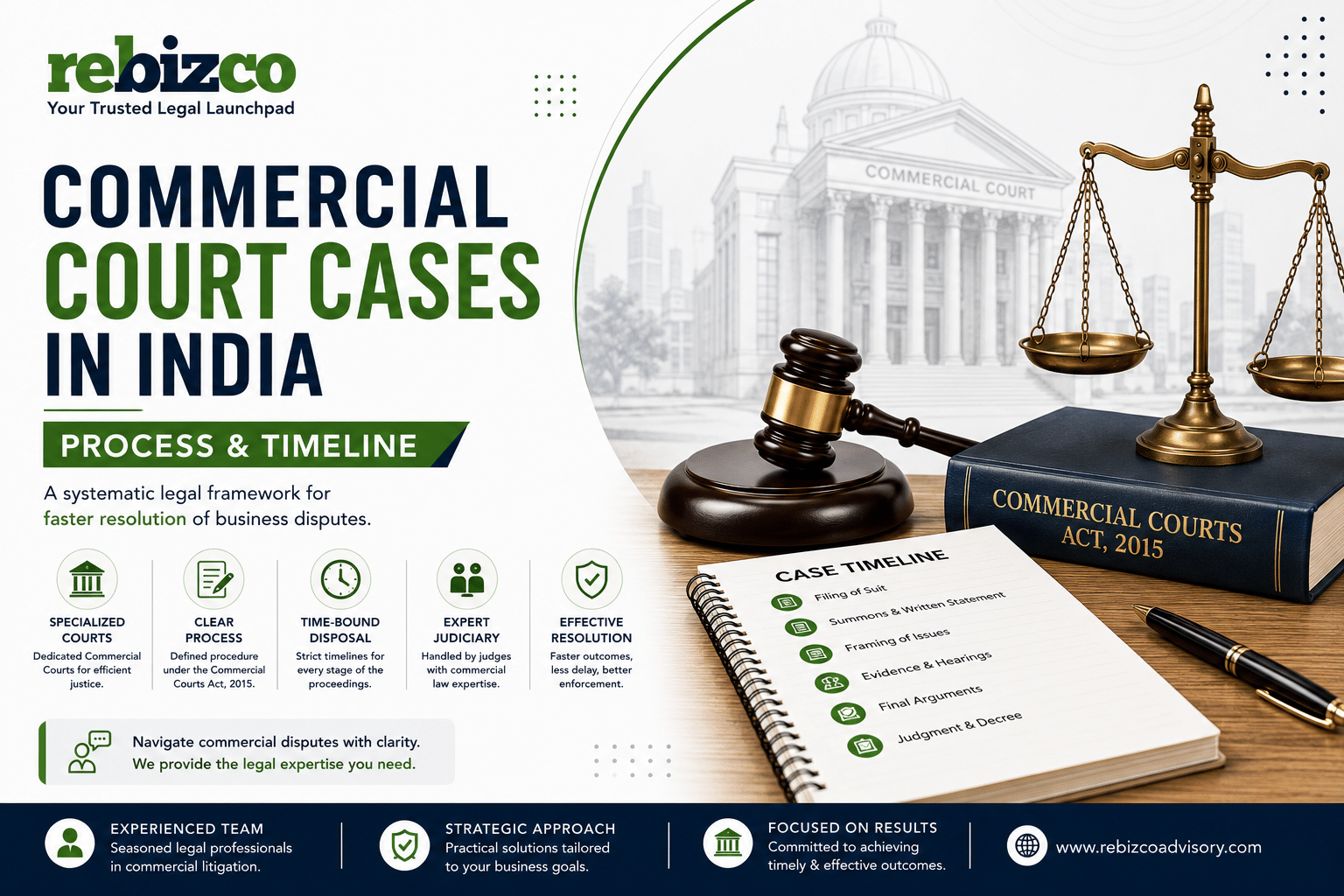
Commercial disputes often arise in business dealings. To handle such matters efficiently, India introduced commercial courts with a structured and time-bound system. This guide explains how these courts work, how you can file a case, and how long the process usually takes. In addition, the blog uses simple language so you can easily understand every step.
What is Commercial Court India Process?
The commercial court India process defines the legal steps used to resolve business disputes in specialized courts under the Commercial Courts Act, 2015. These courts focus only on commercial matters like contracts, trade issues, and financial disputes.
Unlike regular courts, commercial courts follow strict timelines and clear procedures. As a result, they deliver faster outcomes. Moreover, judges in these courts handle business-related cases regularly, which improves decision-making quality.
Types of Business Court Case India Handles
A business court case India involves disputes that arise from business transactions or agreements. These cases usually include financial claims or contractual disagreements between parties.
Typical disputes include breach of contract, partnership conflicts, recovery of money, and shareholder issues. Additionally, the law requires a minimum claim value for a case to qualify as a commercial dispute. Therefore, smaller disputes may not fall under this category.
Commercial Litigation Delhi: Where to File Cases
Commercial litigation Delhi takes place in designated commercial courts within the city. These courts specifically handle high-value and complex business disputes.
You must file your case in the correct court based on jurisdiction and claim value. Delhi courts maintain strict timelines and procedural discipline. Consequently, they resolve cases faster than many other jurisdictions.
Filing Process in Commercial Courts
Understanding the filing process helps you avoid mistakes and delays. The system follows a clear step-by-step structure.
First, parties attempt pre-institution mediation. This step often resolves disputes without court involvement. However, if mediation fails, the plaintiff proceeds with filing the case.
Next, the plaintiff drafts and submits the plaint, which outlines facts, claims, and relief. After that, both parties submit supporting documents such as contracts and invoices.
Then, the court issues summons to the defendant. The defendant responds within a fixed time. Following this, both sides present evidence and arguments. Finally, the court reviews everything and delivers judgment.
This structured approach keeps the commercial dispute timeline India efficient and predictable.
Commercial Dispute Timeline India Explained
The commercial dispute timeline India ensures quicker resolution compared to traditional courts. Each stage follows a defined timeframe.
Mediation usually takes 3–6 months. Filing and summons take around 1–2 months. The evidence stage may continue for 6–12 months. Courts typically deliver final judgments within 1–2 years.
Overall, most cases conclude within 1–3 years. In contrast, regular civil cases often take much longer. Therefore, commercial courts provide a practical solution for businesses.
Court Fees India for Commercial Cases
The court fees India depend on the value of the claim. Higher claims require higher fees. Each state follows its own fee structure.
In Delhi, authorities calculate fees based on the total claim amount. Therefore, businesses should estimate costs before filing a case. Apart from court fees, you should also consider lawyer fees and documentation expenses.
Advantages of Commercial Courts
Commercial courts offer several clear benefits. They resolve disputes faster and follow a structured process. Additionally, strict timelines reduce unnecessary delays.
Judges in these courts understand business laws well. Consequently, they handle cases more efficiently. Businesses prefer this system because it saves both time and resources.
Challenges in Commercial Litigation
Despite the advantages, some challenges still exist. Strict deadlines require quick preparation and strong documentation. Missing timelines can affect your case negatively.
Complex legal procedures may also create confusion for first-time users. Therefore, many businesses seek professional help, especially in commercial litigation Delhi matters.
Commercial Court vs Civil Court
Commercial courts differ significantly from civil courts. They focus only on business disputes, while civil courts handle a wide range of cases.
Commercial courts enforce strict timelines and structured procedures. On the other hand, civil courts allow more flexibility, which often leads to delays. Choosing the correct forum can greatly impact the outcome of your case.
When Should You Use Commercial Court India Process?
You should choose the commercial court India process when your dispute involves contracts, business transactions, or financial claims.
For instance, if someone breaches a contract or fails to make payment, you can file a commercial case. If the claim meets the required value threshold, this system offers a faster and more effective solution.
Conclusion
Commercial courts have transformed dispute resolution for businesses in India. They offer speed, efficiency, and clarity in handling complex matters. Moreover, they reduce the burden on traditional courts.
If you face a business court case India, understanding the process helps you take the right steps. Planning for court fees India and timelines also improves your strategy.
In conclusion, commercial courts provide a reliable and effective way to resolve business disputes. Therefore, businesses should use this system to protect their rights and ensure faster justice.