

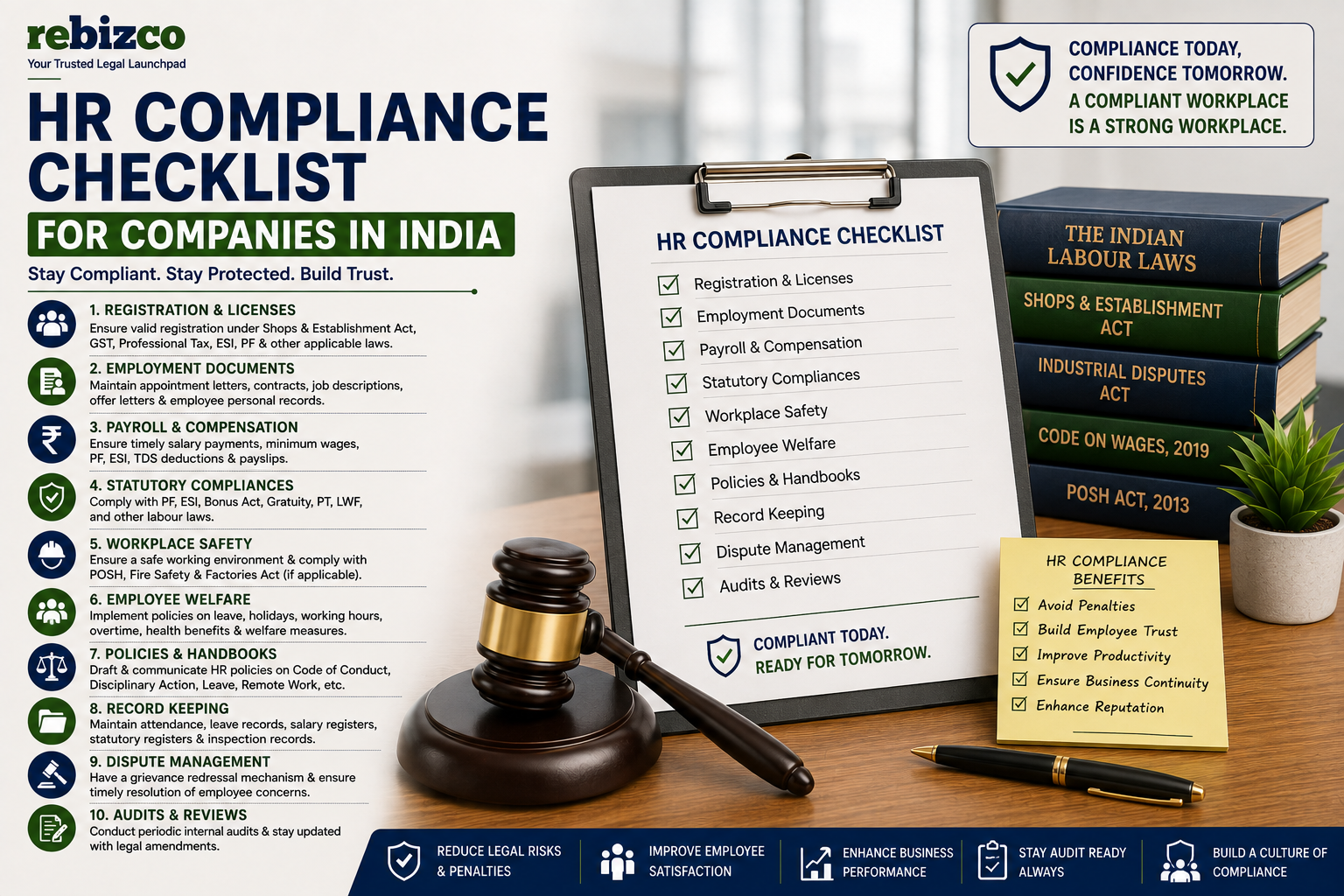
HR compliance plays an important role in running a business responsibly. Companies must follow employment laws, maintain proper employee records, manage wages correctly, and provide legally required workplace benefits.
A company that ignores HR compliance can face notices, penalties, employee disputes, and reputational problems. Small businesses may also face compliance issues if they rely on informal HR practices.
A proper HR compliance India checklist helps businesses identify their legal responsibilities and maintain better employment records.
What Is HR Compliance in India?
HR compliance means following the laws and rules that apply to employees and workplaces.
These requirements can cover wages, working hours, leave, social security, employee benefits, workplace safety, termination, maternity protection, and other employment matters.
The exact requirements depend on factors such as the company’s industry, number of employees, location, wage levels, and type of establishment.
Companies should therefore avoid using the same compliance checklist for every business.
Why Is HR Compliance Important?
HR compliance protects both businesses and employees.
Employees receive their legally required benefits and protections. Companies can reduce the risk of disputes, penalties, and regulatory action.
Proper compliance also creates clear HR processes. Employees understand their rights and responsibilities, while employers maintain evidence of their employment practices.
For companies operating in Delhi, businesses should consider both central employment laws and applicable local requirements.
HR Compliance India Checklist
A company should review its HR practices regularly.
The business should maintain proper employee records, issue appropriate employment documents, follow wage requirements, and manage statutory contributions.
The company should also review workplace policies and ensure that employees receive required benefits.
Basic HR Compliance Checklist
- Employee records: Maintain accurate employee information, joining dates, roles, wages, and employment documents.
- Appointment letters: Provide employees with appropriate written employment terms.
- Wages: Pay employees according to applicable wage requirements and agreed employment terms.
- Working hours: Follow applicable working-hour and overtime requirements.
- Leave: Maintain proper leave policies and records.
- Salary records: Maintain accurate payroll and salary documentation.
- PF compliance: Check whether the organisation falls under EPFO requirements.
- ESIC compliance: Check whether employees qualify for ESIC coverage.
- Gratuity: Track employee service and gratuity obligations.
- Maternity benefits: Follow applicable maternity protection requirements.
- POSH compliance: Maintain the required workplace sexual-harassment prevention mechanism.
- Termination: Follow applicable contractual and legal requirements when ending employment.
Employee Documentation and Records
Good documentation forms the foundation of HR compliance.
Companies should maintain employee records from the beginning of employment. These records can include appointment letters, identification information, salary details, leave records, attendance, performance documents, and exit records.
Employers should also protect employee information and restrict access to authorised personnel.
Accurate records can become particularly important during inspections or employment disputes.
Appointment Letters and Employment Contracts
An employment contract or appointment letter should clearly explain the employee’s role and important employment conditions.
The document can include salary, designation, working hours, notice period, leave rules, confidentiality obligations, and other relevant terms.
Companies should avoid using unclear or outdated templates.
A well-drafted employment agreement can reduce misunderstandings between the employer and employee.
Wage and Salary Compliance
Companies must pay employees according to applicable wage laws and employment terms.
Businesses should review minimum wage requirements applicable to their establishment and category of employees.
Payroll records should accurately show salary, deductions, allowances, and other applicable components.
Employers should also provide salary information or payslips where required.
Incorrect wage calculations can lead to employee complaints and legal disputes.
Working Hours and Overtime
Working hours can depend on the applicable employment law and type of establishment.
Companies should maintain accurate attendance records and follow applicable limits on working hours.
Where overtime applies, employers should calculate and pay overtime according to the relevant rules.
Businesses should avoid treating excessive working hours as an informal arrangement without checking the applicable legal requirements.
Leave and Holiday Compliance
Companies should maintain a clear leave policy.
Depending on the establishment and applicable law, employees may have rights relating to earned leave, sick leave, casual leave, maternity leave, and public holidays.
The employer should maintain leave records and communicate the applicable policy clearly.
Delhi businesses should check the requirements applicable to their particular establishment.
Provident Fund Compliance
Companies covered by EPFO requirements must follow the applicable provident fund rules.
Employers should register eligible establishments and employees where required.
The company must also calculate and deposit contributions within the applicable timelines.
Payroll records should match the company’s PF records.
Employers should regularly check for contribution or employee-data errors.
ESIC Compliance
Businesses covered by the Employees’ State Insurance scheme must follow the applicable ESIC requirements.
Employers should identify eligible employees and make the required contributions.
The company should also maintain accurate employee and ESIC records.
Failure to maintain proper records can create difficulties when employees need ESIC benefits.
Gratuity Compliance
Gratuity can become an important obligation for employers when eligible employees complete the required service.
Companies should maintain accurate joining and exit records.
They should also calculate gratuity using the applicable wage definition and statutory rules.
HR teams should not rely only on old internal policies because gratuity rules and labour-code requirements can change.
Maternity Benefit Compliance
Employers must follow applicable maternity protection requirements.
Eligible employees can receive maternity benefits and other protections according to the law.
Companies should maintain a clear maternity policy and avoid discriminatory treatment based on pregnancy or maternity.
HR personnel should handle maternity-related information carefully and confidentially.
POSH Compliance
Workplace sexual harassment compliance is an important part of workplace compliance India.
Organisations covered by the Sexual Harassment of Women at Workplace Act, 2013 must follow applicable requirements.
This can include establishing an Internal Committee where required, displaying relevant information, conducting awareness activities, and maintaining appropriate complaint procedures.
The organisation should handle complaints confidentially and follow the prescribed process.
Employee Health and Workplace Safety
Workplace safety requirements can vary depending on the industry and establishment.
Factories, construction businesses, offices, shops, and other workplaces may have different safety obligations.
Companies should identify the safety requirements applicable to their business.
Employers should also maintain appropriate emergency procedures and communicate safety policies to employees.
HR Policies Every Company Should Review
A company should create HR policies that match its size and business activities.
Common policies can cover attendance, leave, remote work, workplace conduct, confidentiality, information security, disciplinary procedures, and grievance handling.
Companies should avoid copying policies from another organisation without checking whether they fit the business and applicable law.
Policies should also remain consistent with employment contracts.
Employee Grievance Mechanism
Employees should have a clear way to raise workplace concerns.
A grievance mechanism can help employees report issues involving salary, working conditions, workplace behaviour, leave, or other employment matters.
HR teams should record complaints and handle them according to the company’s policy and applicable law.
A timely response can prevent minor workplace issues from becoming major disputes.
Labour Law Compliance Delhi Companies
Companies operating in Delhi should pay attention to applicable central and Delhi-specific employment requirements.
The exact obligations can depend on whether the business operates as a shop, commercial establishment, factory, office, or another type of workplace.
The number of employees can also affect certain compliance requirements.
Businesses should therefore identify their establishment category before preparing their compliance plan.
HR Compliance for New Employees
Compliance begins when a new employee joins.
The company should collect the required information, issue employment documents, complete applicable statutory registrations, and explain workplace policies.
Payroll and statutory benefits should also start correctly.
New Employee Compliance Steps
- Collect employee information: Obtain the required personal and employment details.
- Issue employment documents: Provide the appointment letter or employment agreement.
- Complete statutory registrations: Register the employee under applicable schemes.
- Set up payroll: Enter salary and deduction details correctly.
- Explain policies: Inform the employee about important workplace rules.
- Maintain records: Store employment documents securely.
Monthly HR Compliance
HR compliance should not become a once-a-year activity.
Companies should review payroll, attendance, leave, statutory contributions, and employee records regularly.
Monthly checks can help identify mistakes before they become larger problems.
Monthly Compliance Checks
- Review payroll: Check salary calculations and deductions.
- Check statutory payments: Verify applicable PF, ESIC, and other contributions.
- Review attendance: Confirm working hours and overtime records.
- Update employee records: Record new employees, exits, and changes.
- Check leave records: Update employee leave balances.
- Maintain documentation: Keep payment and compliance records organised.
Annual HR Compliance
Some HR obligations require periodic or annual action.
Companies should identify applicable returns, registers, policy reviews, training requirements, and statutory filings.
The exact annual requirements depend on the business and applicable laws.
HR teams should maintain a compliance calendar to avoid missing deadlines.
Employee Exit and HR Compliance
HR compliance continues until an employee leaves the company.
The employer should follow the applicable resignation, notice period, termination, salary settlement, and statutory-benefit requirements.
The company should also issue appropriate exit documents where required.
HR should calculate outstanding salary, leave-related amounts, gratuity where applicable, and other contractual or statutory dues.
Full and Final Settlement
A proper full and final settlement can reduce post-employment disputes.
The company should calculate the employee’s outstanding salary and other applicable amounts.
HR should also check whether any deductions have a valid contractual and legal basis.
Employees should receive appropriate settlement documentation.
HR Compliance Audit
An HR compliance audit helps companies identify gaps in their employment practices.
The audit can cover employee records, payroll, contracts, statutory registrations, benefits, workplace policies, and exit procedures.
Companies can conduct internal reviews or seek professional assistance.
HR Compliance Audit Steps
- Review employee records: Check whether files contain the required documents.
- Review contracts: Check employment agreements and appointment letters.
- Check payroll: Verify wages and deductions.
- Check statutory benefits: Review PF, ESIC, gratuity, and other applicable benefits.
- Review policies: Ensure workplace policies remain current.
- Check POSH compliance: Verify applicable committee, training, and documentation requirements.
- Review exits: Check resignation and termination procedures.
- Prepare a correction plan: Fix identified compliance gaps and assign responsibility.
Benefits of HR Compliance
Following HR laws can provide important benefits for businesses.
Key Benefits
- Reduces legal risk: Proper compliance can reduce avoidable employment disputes.
- Protects employees: Workers receive applicable statutory benefits and protections.
- Improves HR processes: Clear procedures make employee management easier.
- Supports business reputation: Responsible employment practices build trust.
- Improves record keeping: Accurate documents help during disputes and inspections.
- Prevents costly mistakes: Regular reviews can identify problems before they become serious.
Common HR Compliance Mistakes
Companies often create compliance problems by relying on outdated policies or informal practices.
Some businesses fail to update employee records after changes in salary or designation.
Others do not maintain proper attendance, leave, or statutory contribution records.
Another common mistake involves using the same employment contract for every employee without considering their role or applicable legal requirements.
Regular compliance reviews can help businesses identify these issues.
How Companies Can Improve HR Compliance
Businesses should create a compliance calendar based on their actual legal obligations.
The HR team should review employment contracts and policies regularly.
Payroll and statutory records should remain accurate and consistent.
Companies should also train HR personnel and managers on important workplace requirements.
For complex employment matters, businesses can consult an employment lawyer or labour-law professional.
Conclusion
HR compliance is an essential part of responsible business management in India. Companies must understand the employment laws that apply to their establishment and maintain proper records throughout the employee lifecycle.
A practical HR compliance India checklist should cover employment contracts, wages, working hours, leave, PF, ESIC, gratuity, maternity benefits, workplace safety, POSH requirements, employee grievances, and exit procedures.
Businesses in Delhi should also review labour law compliance Delhi companies requirements that apply to their specific type of establishment.
Understanding HR legal rules India can help companies create better employment policies and reduce unnecessary disputes. Regular audits can also identify compliance gaps before they result in regulatory or employee action.
Companies should remember that company compliance India HR requirements can differ depending on factors such as employee strength, industry, establishment type, and location.
Ultimately, effective workplace compliance India requires regular monitoring rather than a one-time review. Businesses should keep their policies updated, maintain accurate records, and seek professional advice when a legal issue requires specialised interpretation.